The research achievement titled A low-cost picowatt calorimeter using a flexible printed circuit board by Prof. Pavel Neuzil's group at the School of Mechanical Engineering, Northwestern Polytechnical University, was published in Nature Communications. This study was supported by funding from the National Natural Science Foundation of China and the National Key Research and Development Program of China, among other projects. Hanliang Zhu, a Ph.D. student at the School of Mechanical Engineering, served as the first author, while Prof. Pavel Neuzil and Prof. Luke P. Lee from Harvard University served as the co-corresponding authors of the paper.
Calorimeters are highly sensitive tools for directly measuring heat changes in chemical reactions and biological processes. Existing chip calorimeters, relying on MEMS (Micro-Electro-Mechanical Systems) processes, have achieved sub-nanowatt-level heat flow detection resolution. However, there is a compatibility challenge between the micron-scale fabrication precision of MEMS technology and the hundred-micrometer-scale chip dimensions required for liquid detection. Critical steps such as multi-step photolithography, metal deposition/etching, and membrane release contribute to process redundancy and increased costs.
Prof. Pavel's research group proposed the concept of a calorimeter using flexible printed circuit (FPC) technology and subsequently designed a picowatt-level calorimeter based on FPC processes integrated with surface-mounted thermistors. The calorimeter is fabricated directly on flexible copper-clad laminates (FCCL) using FPC technology, eliminating the complex patterning and membrane release steps required in MEMS processes, thereby reducing manufacturing inconsistencies and costs. The calorimeters employed standard thermistors for temperature measurement. They incorporated hollowed-out structures to minimize thermal loss, achieving thermal conductance and heat flow sensitivity of 109.0 µW·K-1 and 227 V·W-1, respectively, positioning it at the forefront of liquid measurement calorimeters. A low-noise, stable measurement system tailored for liquid samples was developed, achieving temperature and heat flow resolutions of 6 µK and 654 pW, enabling simultaneous monitoring of sample morphology and thermal changes. The study demonstrates that the FPC-based microcalorimeter delivers high-performance detection while significantly reducing process complexity and R&D expenses.
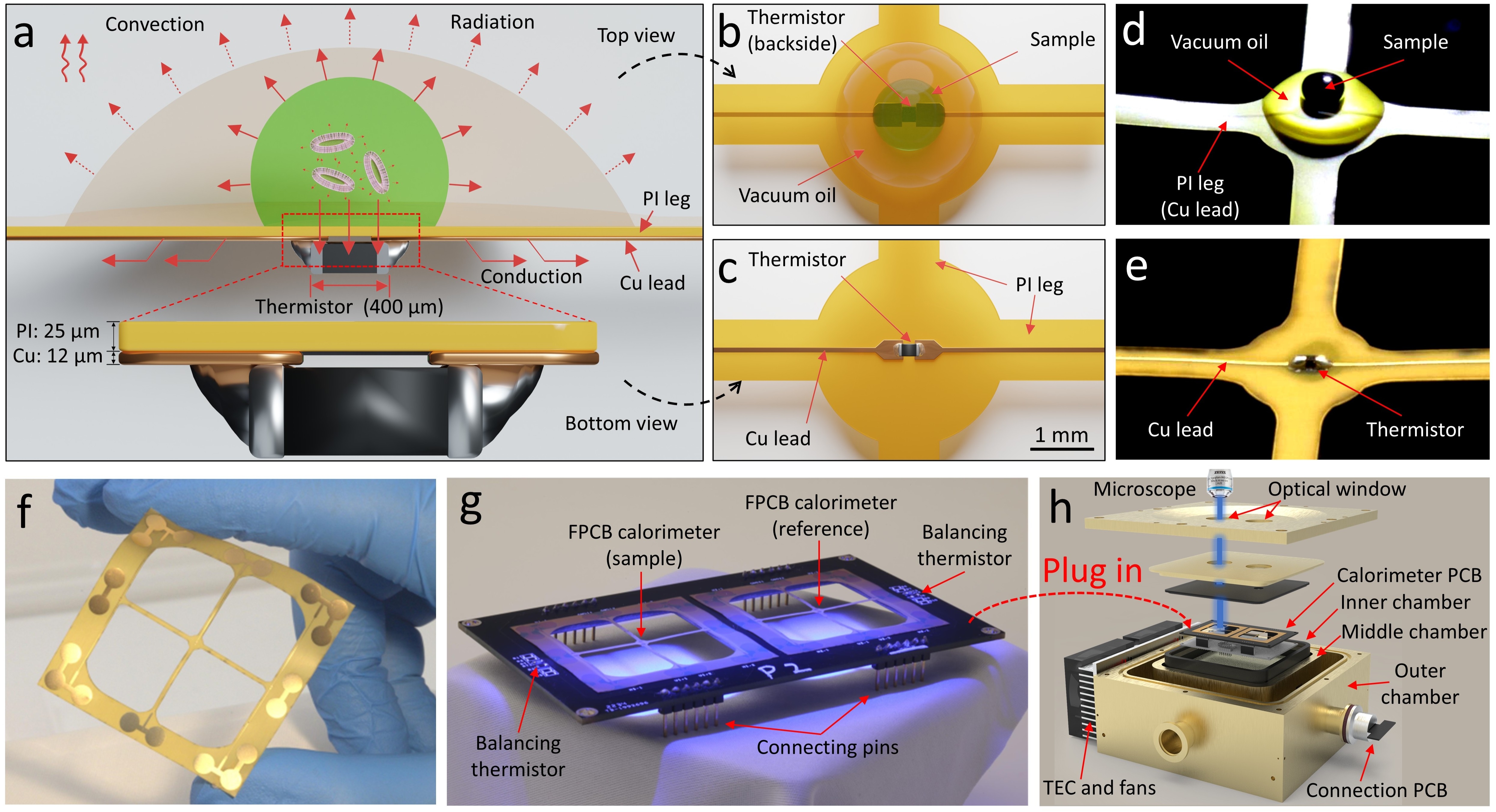
Figure 1: The FPC-based picowatt-level calorimeter and integrated morphology-heat synchronous monitoring platform developed by Northwestern Polytechnical University (NPU).
Prof. Pavel Neuzil is a professor at the School of Mechanical Engineering, Northwestern Polytechnical University, as a National Specially-Appointed Expert since 2015. He co-founded the Micro-Nanofluidic Technology Talent Hub Laboratory with Prof. Honglong Chang and serves as its Chief Scientist. Prof. Pavel has deep knowledge of electrical and mechanical engineering, physics, chemistry, analytical chemistry, and optics. His research interests are miniaturized medical and analytical devices, integrated smart instruments, and nanotechnology. He published over 250 high-profile journal and conference papers, including Nature Medicine, Nature Reviews Drug Discovery, Nature Communications, Angewandte Chemie, Nano Letters, etc. He also submitted over 20 international patent applications, of which 15 were granted. He has 8,700 citations, and his H-index is 42. He is an editor of the Elsevier journal Applied Materials Today. In 2023, he received the Chinese Government Friendship Award for outstanding contributions to scientific research and talent cultivation in China.
URL:https://doi.org/10.1038/s41467-025-58025-9